What if the line between the world you see and the world you experience could simply disappear? The first time you put on a good VR headset, there is usually a moment when the illusion takes hold. You look down and the floor seems to drop away, or a virtual object drifts toward your face and you flinch. For a second, your brain forgets that you are standing in the living room.
That feeling has a name: immersion, or what researchers often call presence, the sense of actually being somewhere. It is the whole point of augmented reality (AR) and virtual reality (VR), and it is surprisingly hard to produce. Early attempts made people dizzy, bored, or both. Getting from those clunky experiments to today’s VR headsets and smart glasses took decades of small breakthroughs.
One helpful way to understand that journey is to stop thinking of immersion as a single feature. It is a recipe. Take away any one ingredient and the illusion falls apart. Here are the six that matter most, and how each one has grown up.
Ingredient 1: Sight
Vision is the obvious place to start, because it is the sense we lean on most.
The earliest head-mounted displays (the ancestors of today’s VR headsets), built in the 1960s, showed simple wireframe shapes. Computer scientist Ivan Sutherland’s 1968 system, nicknamed the Sword of Damocles, was so heavy that it hung from the ceiling on a mechanical arm. What you saw through it was little more than glowing outlines of a room.
By the early 2010s, VR was enjoying its modern revival. The first widely shared developer VR headsets had screens on which individual pixels were clearly visible, like peering at the world through a screen door. Their field of view, meaning how much of your vision the image fills, was around 90 degrees, while human vision covers well over 180 degrees horizontally. Wearing one felt like looking through a pair of ski goggles.
Since then, three things have improved dramatically.
- Sharpness: Modern VR headsets pack far more pixels into each eye, and the newest displays are getting close to the point where individual pixels disappear. Engineers measure this in pixels per degree. Normal human vision can resolve around 60, and the latest hardware is steadily closing in on that figure.
- Smoothness: Screens now refresh 90 times a second or more, rather than the 60 of an ordinary monitor. That sounds like a minor detail, but a slow or flickering image is one of the fastest ways to break the spell and give people a headache.
- Smart rendering:
Your eyes only see sharply in a tiny spot at the center of your gaze. Newer systems use eye tracking to draw that spot in full detail and everything else more roughly, a trick called foveated rendering. It saves enormous computing power and makes high-quality visuals possible on small, battery-powered devices.
The result is that sight went from a rough sketch to something the brain increasingly accepts as real.
Ingredient 2: Tracking
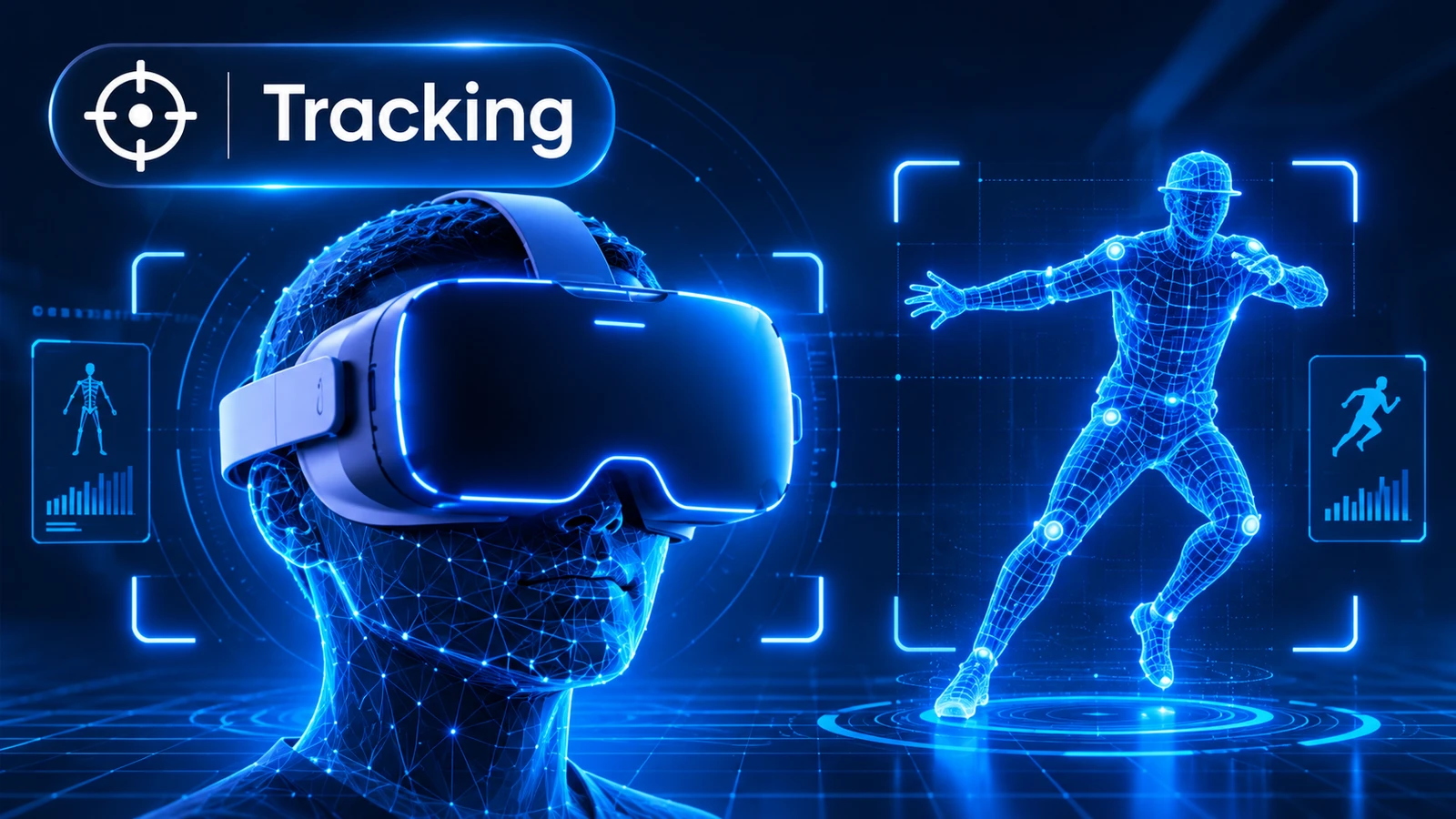
Here is a secret about immersion: sharp graphics matter less than you would think. What matters more is that the world holds still when you move.
In real life, when you turn your head, the scene shifts instantly and perfectly. A virtual world has to match that. If there is a delay between your movement and the image updating, even a fraction of a second, your brain notices the mismatch. Many developers treat roughly 20 milliseconds as the point beyond which things start to feel wrong. Go past it and users begin to feel uneasy, and sometimes nauseous.
That nausea is not a mystery. It happens when your eyes tell you that you are moving but your inner ear, which senses real motion, says you are sitting still. Your brain interprets the disagreement as a possible sign of poisoning, which is why VR sickness feels like food sickness.
Tracking has gone through a quiet revolution. Early systems relied on external sensors placed around a room, which had to be carefully set up and kept in place. Then came a shift to what is called inside-out tracking. Cameras built into the VR headset watch the room and work out where you are by recognizing walls, furniture, and edges, the same way you might orient yourself in a dark room by feeling familiar objects. In 2019, Meta’s Quest VR headset brought this to a mainstream standalone product, and setup effectively became “put it on.”
Tracking also grew from following only your head to following your whole body. Modern systems track both hands, and some follow your eyes, your face, and even your posture. Each addition makes a virtual presence feel less like a camera floating through space and more like you.
I learned how unforgiving this is while building a ring try-on simulator. The app used a hand-tracking tool to find a person’s fingers through the camera and place different styles of rings on them in real time. It was reasonably accurate, but the rings would sometimes jitter. That small shake was enough to break the illusion, because people look very closely at a small object in their own hand. It was a good reminder that in AR, being in the right place is not enough. The object has to stay there, frame after frame.
Ingredient 3: Sound
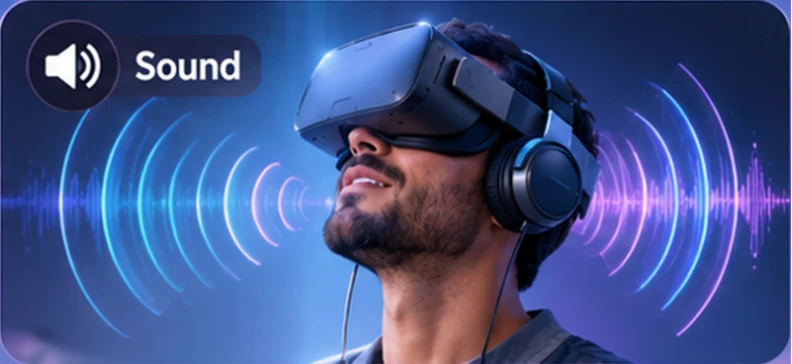
Close your eyes in a busy cafe and you can still tell where the coffee machine is, where someone is walking behind you, and which table is laughing. Your ears are constantly building a map of space.
Early VR and games treated sound as an afterthought: stereo audio that played in your left or right ear. Spatial audio changed that. The idea rests on a simple fact. The shape of your head and ears subtly changes how a sound reaches each ear depending on where it comes from. A noise from the left arrives slightly earlier and louder in your left ear, and the folds of your outer ear color it in ways your brain has learned to decode since infancy. Software can now imitate those cues, so a sound seems to come from a specific place in the room.
The key trick is combining that with head tracking. When you turn your head, the sound stays anchored where it was, exactly as in real life. A voice that was to your left is now behind your shoulder. Without that, audio feels glued to your head and the illusion quietly collapses.
Sound does more than add realism. It guides attention, builds mood, and can make a small virtual space feel enormous or a large one feel intimate. Many developers will tell you that great audio rescues a mediocre scene far more often than great graphics rescue bad audio.
Ingredient 4: Touch and interaction
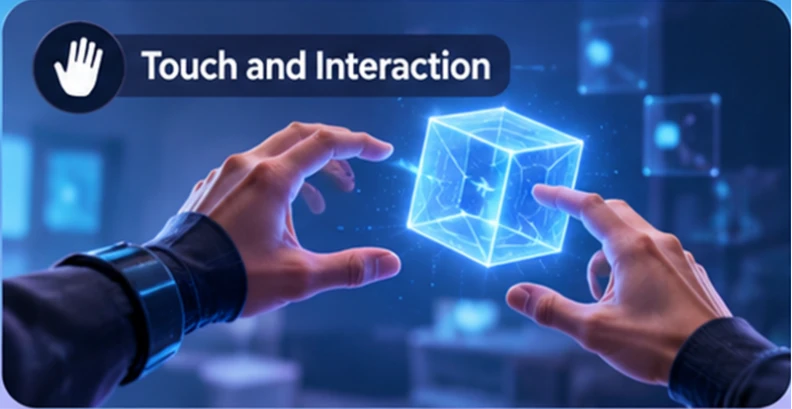
Seeing and hearing the world is one thing. Doing something in it is what makes it yours.
The first interactions in VR were borrowed from older technology: keyboards, mice, and gamepads. They worked, but they reminded you constantly that you were operating a computer. In 2016, motion controllers arrived that let you reach out, grab, throw, and point, and that was a turning point. Suddenly your hands existed in the virtual world.
The next step removed the controllers entirely. Hand tracking uses the VR headset’s cameras to see your fingers and translate them into actions, so you can pinch, push, and wave with nothing in your grip. Some VR headsets add eye tracking, letting you select things just by looking and tapping your fingers together. The interface starts to disappear into ordinary gestures.
Interaction was the main lesson in two of my VR projects. One was a virtual tour of the Taxila Museum, with stupas and objects you could explore and interact with, each carrying its own information. Attaching the information to the objects themselves, instead of to a label on a wall, turns a museum visit into something you do rather than something you read.
The other was a virtual island tour; my small-scale take on Jurassic Park, with six or seven species of dinosaurs roaming around. They looked impressive, but they did not react to each other or to me. That limitation is a good example of how much a world needs to respond to feel alive.
A dinosaur that ignores you is scenery. One that notices you is an event.
Touch is the hardest sense to bring along. Controllers can vibrate, and that small vibration when you grab an object does a surprising amount of work. Specialized gloves and wearable devices can push back against your fingers or simulate texture, but they remain expensive and mostly confined to research labs and training rooms. For now, most virtual objects have no weight, no temperature, and no surface. Closing that gap is one of the biggest open challenges in the field.
Ingredient 5: Comfort and freedom
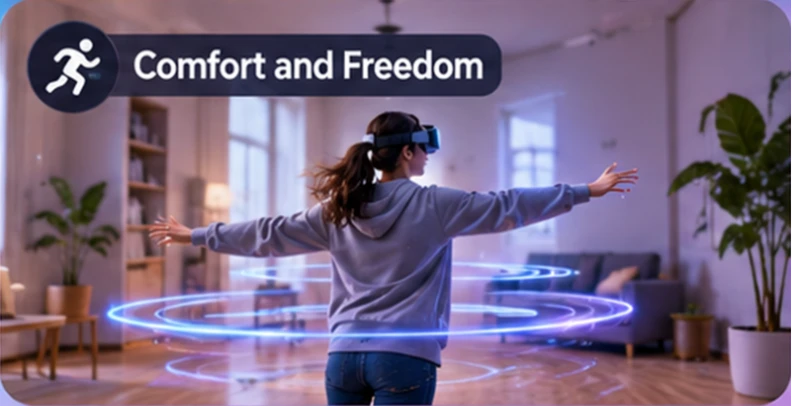
Immersion is fragile. Anything that reminds you of your own body or your surroundings, such as a tight strap, a pulling cable, or a sore nose, pulls you out.
For years, the best VR required a powerful computer connected to the VR headset by a thick cable. You had to be careful not to trip on it, and the cable tugged on your head whenever you turned. VR headsets were heavy and front-loaded, so after twenty minutes you felt it in your neck.
The breakthrough was the standalone VR headset: all the computing built in, no cable, no external sensors. It made VR something you could use in a living room, a classroom, or a hotel room. Weight distribution improved, straps got smarter, and lenses became thinner and lighter.
VR headsets are still a bit like wearing a small pair of ski goggles for a long time, though, and the industry’s attention has shifted to something lighter. Today’s smart glasses, which add a camera, speakers, and an AI assistant to an ordinary frame, weigh not much more than ordinary sunglasses. At its Connect event in September 2026, Meta announced a pair of slim smart glasses that it says weigh around a hundred grams, though they connect by a cable to a small pocket unit and are not due until spring 2027. Whether that particular product succeeds or not, it shows the direction: immersive technology that fades into something you would barely notice wearing.
In other words, the best immersive hardware is quickly becoming the hardware you forget about.
Ingredient 6: Mixing with reality
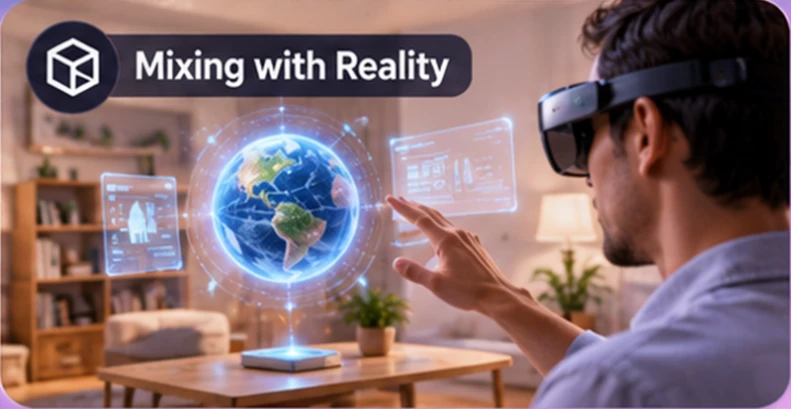
So far, we have mostly talked about VR, where the real world is replaced. The sixth ingredient is where AR comes in, and it is arguably the most important one for the future.
Augmented reality began as a way to add information to what people already see. Fighter pilots got heads-up displays decades ago. In 1990, a Boeing researcher coined the term “augmented reality” while working on tools to guide workers assembling aircraft wiring.
Many sports fans have been seeing a simple version since 1998, whenever a bright yellow line appears across a football field on TV, painted into the picture by software.
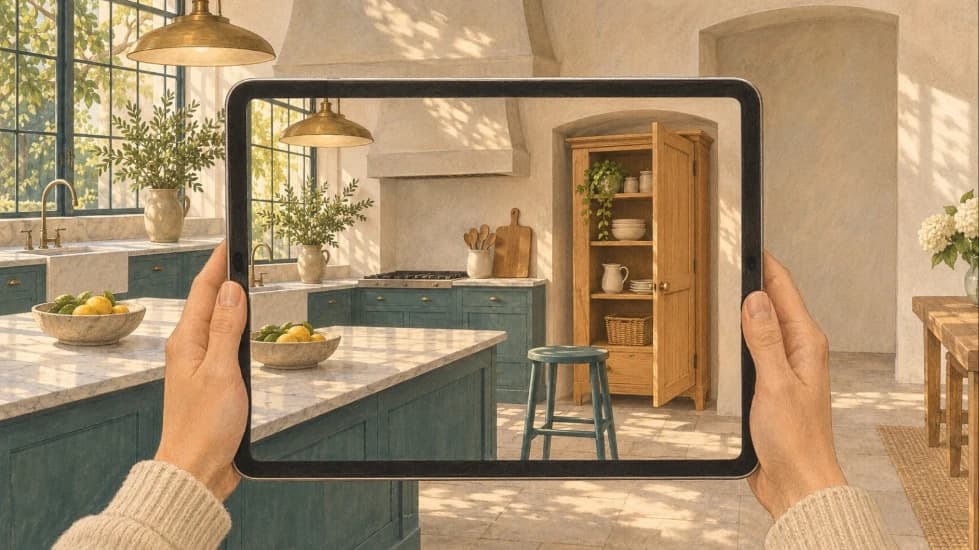
AR reached the public in July 2016, when Pokémon Go put digital creatures on streets and in parks, all through a phone screen. Phone makers soon added built-in AR tools, with Apple’s ARKit arriving in September 2017 and Google’s ARCore following in early 2018. Millions of people could then drop a virtual chair into their room before buying it. The phone showed the idea, but holding a phone up in front of your face is a poor way to blend two worlds.
My own AR projects live in this camera-based world:
- Engine recognition. The app recognized two car engines and one plane engine and showed hotspots on them, built from the engines’ manuals, that labeled each part. Point the camera at an engine, and it tells you what you are looking at.
- Ghost hunter. This game sent players across a city by GPS, from one location to another. At each stop, the player had to find a real-world capture device using object detection, then catch a virtual ghost using a small ESP32-based remote. There were 13 ghosts in all.
Both projects taught me the same thing: AR is most convincing when the digital layer is tied to something real, whether that is a machine on a workbench or a street corner across town.
The next stage came from mixed-reality headsets with color passthrough cameras. They show you the real room through video, and software places virtual objects in it, often so convincingly that you reach to touch a table that is only partly real. These mixed-reality headsets can slide between full VR and a blend of real and virtual as needed, turning your actual room into the stage for a game, a movie screen, or a work desk.
Now the goal is glasses. Instead of showing you a video of the room, smart glasses let you see through clear lenses while light from tiny displays adds digital information on top. The optics are enormously difficult, which is why most smart glasses sold today have no display at all and offer a camera, speakers, and an AI assistant. But the direction is set. The long-term vision is a layer of useful, context-aware information that sits in the real world rather than replacing it.
How the ingredients work together
The interesting thing about this recipe is how the pieces depend on each other. Sharp visuals are wasted if tracking lags. Spatial audio is useless if the sound does not follow your head. Hand tracking feels magical only if the image responds instantly, and none of it holds up if the VR headset is too heavy to wear for more than twenty minutes. Immersion is the product of every ingredient working at once, and a single weak link breaks it.
Immersion is the product of every ingredient working at once, and a single weak link breaks it.
My own VR projects offered a small experiment on this. All four can also be played on a regular PC with a simple controller, but you do not get the best experience. The content is identical. What changes is that the ingredients go missing: natural head tracking, a view that surrounds you, and the sense of your own hands being there.
That is also why progress has often felt slow. Engineers were not improving one thing. They were trying to bring six things up to the standard of the human senses at the same time, inside a device small enough to wear and cheap enough to sell.
What makes the effort worthwhile is what the combination allows. In a virtual classroom I built to teach about landslides, learners could watch simulations of a slide, see its after-effects, learn about the types of rock in the area, and explore the data captured before, during, and after the event. Seeing that whole sequence up close, rather than as a diagram in a textbook, is the kind of use that makes the six ingredients more than technical showpieces.
Culture is another place where it pays off. My latest VR project is a story-driven game in which players photograph old buildings and structures in the historic parts of Rawalpindi, Lahore, and other Pakistani cities. It turns looking closely at a place into the goal of the game.
1962: The Sensorama, an arcade-style booth, plays a short film with vibration, wind, and scents.
1998: Ivan Sutherland’s VR headset, the Sword of Damocles, tracks head movement and shows simple 3D shapes.
1990s: A first wave of VR hype fades, held back by cost, low-quality graphics, and discomfort. Early augmented reality appears in industry and broadcasting.
2012 to 2016: A new generation of VR headsets revives the medium with better screens, faster tracking, and motion controllers. Pokémon Go introduces AR to the mainstream.
2019 onward: Standalone VR headsets remove cables and external sensors. Hand tracking and color passthrough arrive.
2023 to today: Smart glasses with cameras and AI sell in growing numbers. Companies shift attention to lighter, glasses-style devices.
What comes next
The missing pieces are clear. Displays still need to get brighter and sharper while shrinking into ordinary frames. Batteries need to last all day without heating up your face. Touch needs to move beyond vibration in a controller. And the real world needs to be understood well enough for digital objects to behave as if they belong in it.
If history is any guide, none of these will arrive all at once. Each will improve quietly, and one day, without a dramatic announcement, someone will put on a pair of glasses and realize the digital and physical worlds have stopped feeling separate.
That will be the sixth ingredient meeting the other five. And like the best immersive moments, it will probably happen when you are not thinking about the technology at all.